

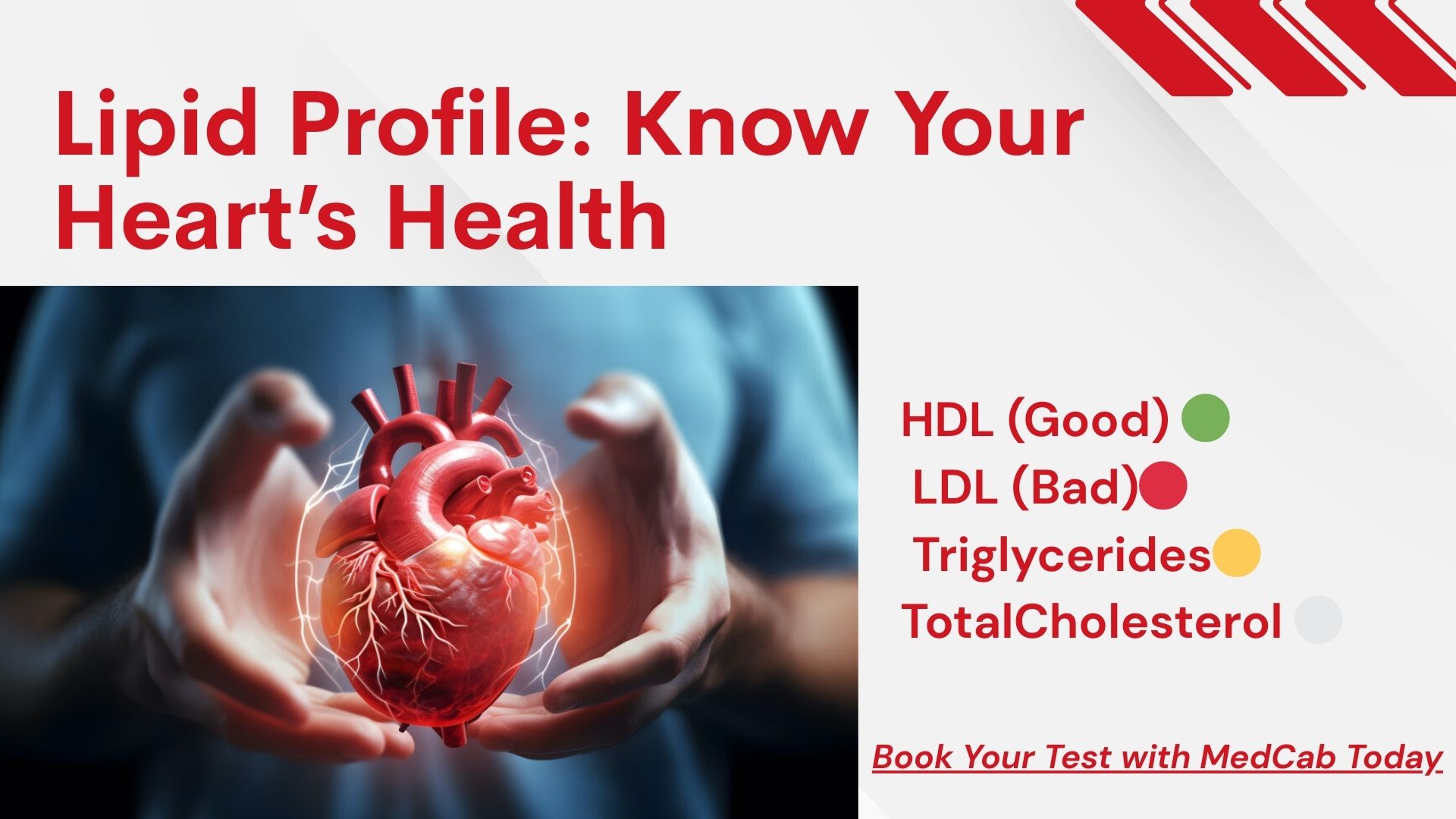
Understanding Lipid Profile Tests
Introduction
Lipid profile tests are an essential part of understanding heart health. The test has various markers that can help assess if you are at risk for cardiac diseases, such as stroke, heart attack and heart failure. Regular monitoring of your heart health can help you make necessary lifestyle adjustments that support the good health of your heart. Some individuals are also at risk for cardiovascular diseases, and these can be prevented with the help of regular blood tests relevant to the heart, such as a lipid panel.
Get your heart profile check up with Med Cab’s pathology and rapid sample collection services. Med Cab offers home sample collection services at a time and location of your convenience. Book a heart health package today with Med Cab.
Relationship of Lipid Profile Tests with Heart Health
A lipid profile test, also known as a lipid panel, reflects your body’s cholesterol profile. A lipid profile test assesses heart and blood vessel health. Essentially, the lipid panel reflects the fats in your blood, such as cholesterol and triglycerides. These can help assess the risk for cardiovascular diseases like heart attacks, hypertension and strokes. Levels of bad fats can be detected through an elaborate cholesterol profile. These fats can cause plaque buildup in arteries, while good fats help remove cholesterol. Good fats are important for guiding preventive care and monitoring treatment effectiveness. A regular lipid panel is particularly important for a person at risk, such as someone with diabetes, obesity, or a family history of heart disease.
The following components are measured with the help of a lipid profile test –
- Total Cholesterol: The sum of all cholesterol in your blood.
- Low-Density Lipoprotein Cholesterol: Known as 'bad' cholesterol, high levels can lead to plaque buildup in arteries.
- High-Density Lipoprotein Cholesterol: Known as 'good' cholesterol, it helps remove excess cholesterol from the bloodstream.
- Triglycerides: Another type of fat found in the body that is a risk factor for heart disease when levels are high.
- Very Low-Density Lipoprotein Cholesterol: High levels can also contribute to plaque deposits on artery walls.
How to Prepare for the Lipid Panel Test?
There are some important measures you should take before getting a lipid profile test. These measures are important for getting accurate and medically relevant results. You must fast for 9 to 12 hours before the test. If you do not fast, only certain values of the test will be considered medically relevant, such as the total cholesterol levels. The other levels may not be considered accurate without fasting.
Furthermore, it is also important to provide the details of any medicines and supplements you are taking during and even before the lipid panel test is done. You can wear loose clothing for the period of the test, so that the needle for the blood test can be easily inserted. The test follows a simple procedure, and your results will be available within 24 hours.
What do the Lipid Profile Test Results Mean?
The lipid profile test results will reflect a number of markers which be indicative of good or poor heart health. The meaning of the results is explained below –
- Total Cholesterol: Should be less than 200 mg/dL. Higher levels are indicators of an increased risk for cardiac diseases.
- LDL Cholesterol: Less than 100 mg/dL. High LDL levels increase heart disease as well as stroke risk.
- HDL Cholesterol: 60 mg/dL or higher. HDL levels should be high. Low levels of HDL are linked to a higher risk of heart disease.
- Triglycerides: Less than 150 mg/dL. High levels are associated with an increased risk of heart disease, stroke, and pancreatitis.
Heart Health Tests with Med Cab
Med Cab Pathology services offer rapid sample collection at a time and place of your convenience. Med Cab’s pathology services offer various tests for the heart, such as lipid profile panel, CBC, CRP, and more. With Med Cab’s fast sample collection services, the blood sample collection process is very convenient. Med Cab’s home sample collection services also help you avoid visits to the pathology labs. Med Cab will provide you with timely digital reports that can be accessed easily through email or via the Med Cab mobile app. For heart health, Med Cab offers the following cost-effective packages –
- Med Cab Healthy Heart – Basic: includes a variety of tests such as Glucose Fasting (BSF), CBC Profile, ESR, HbA1C (Glycosylated Haemoglobin), High Sensitivity CRP, KFT (Max), Lipid Profile, LFT (Max), Urine Profile test and covers 73 parameters.
- Med Cab Cardiac Basic Package: includes a variety of tests such as Complete Blood Counts (CBC), Lipid Profile, Creatine Kinase (CK), Glucose (Fasting), HsCRP, Glycosylated Hemoglobin (HbA1C), Urine Profile test and covers 52 parameters
- Med Cab Cardioplus – Comprehensive: includes 19 important tests such as Apolipoprotein A1 , B, CBC, ESR, BSF, HbA1C, CRP, KFT, Lipid Profile, Homocysteine, LFT, Thyroid test, Vitamin tests, APTT, PT/INR.
Conclusion
In conclusion, a regular lipid profile test is important for understanding your heart health. A lipid profile test has various markers which can indicate your risk for various cardiac diseases, such as stroke. With the help of the lipid profile test, you can make necessary lifestyle and dietary changes that favour your heart health. Get your lipid profile checked with Med Cab today. With Med Cab’s cost-effective packages for pathology services, you can get a full body preventive check up and stay ahead of your health.
